2. Two Hundred Years of History
Beginning in 1826, through financial investment and hired labor, the Concord Mill Dam Company changed the face of downtown Concord. The company drained the original mill pond, replaced old buildings, sold lots, and managed tenants, bringing Concord's business district into a new era. The Anderson Market building was one of the first Mill Dam Company efforts. During the nineteenth century, the site was occupied by a variety of businesses, including a hattery, a watch and clock repair shop, a milliner, a tinsmith, a barber, and more. Henry David Thoreau surveyed the property in 1853 and 1855, making updated notes in the second survey following the building's acquisition by Asa Collier. In October 1856, the building became the subject of a court case. In 1860, lawyer John Shepard Keyes used the building as his office. During the latter part of the nineteenth century, it became a grocery store, which, despite changing hands several times, persisted well into the twentieth century.
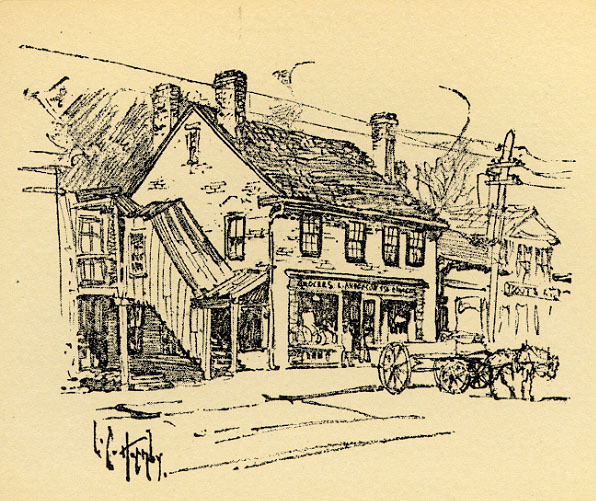
In the twentieth century, events in the building's history mirrored those occurring in Concord at large. In 1913, a time when town demographics were shifting, Norwegian immigrant Lars Anderson purchased the building. In the early 1930s, historically-conscious renovations were made to the market's façade as a response to the increasingly generic appearance of Milldam buildings at the time. A few years earlier, Anderson Market had been threatened by would-be developer Albert Y. Gowen. Gowen was inspired by the recent razing and rebuilding of Williamsburg, Virginia, for the Colonial Williamsburg living history museum, and wished to undertake a similar project in Concord's downtown. The proposal was hotly debated and eventually withdrawn. The building—by then, a century old—survived, as did others on the Milldam.
Beyond exemplifying the history of Concord's built landscape, the building at 42-44 Main Street also tells the story of the Andersons, a deeply rooted Concord family who have contributed to the town in many ways. Beginning with the arrival of Lars Anderson from Loiten, Norway, in 1889 to the present-day management of Main Street's Market & Café by David and Karen Anderson, four generations of the family have lived and worked in Concord, impacting and enlivening the town's business, social, and cultural life.
When the Anderson Market building, the Concord Bank, and other Mill Dam Company buildings were constructed along Main Street, they symbolized Concord's ability to ability to move forward into the future. Their resilient endurance after nearly two hundred years of use allows us to see Concord's past as integral to its pragmatic, functioning present.