12. Rebuilding Damon Mill, 1862-1864
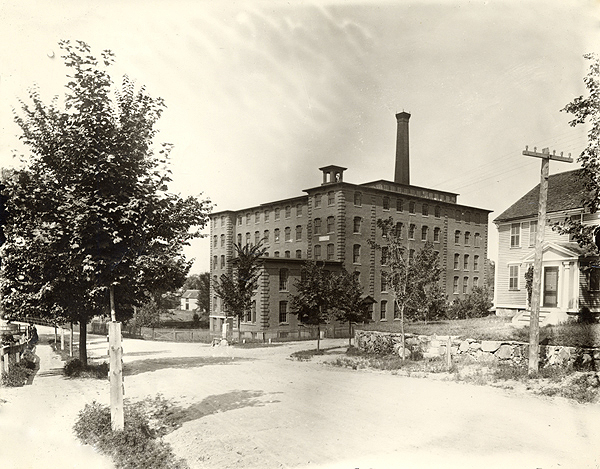
Though the original wooden structures burned to the ground in 1862, within a few months the mill was transformed. Edward Damon commissioned Worcester-based architect Elbridge Boyden (1819-1896) to design the new building. Primarily a designer of commercial and government buildings, Boyden had a national reputation. His work included Mechanics Hall and portions of the Polytechnic Institute of Worcester.
Like Concord’s Town House, the new Damon Mill was designed in the Italianate style popular during the mid-to-late nineteenth century. The main complex consists of eight attached sections that range from one to six stories in height, constructed from locally-produced red brick and the corners emphasized with quoins. In addition to a new main building, several other new elements were added, including a a dye house and a large brick storage building. Older buildings were moved and converted into tenement housing for workers. Because of the distance to the nearest shopping area, a company store was built, with only a small profit made by Damon on the goods sold.
The new mill was equipped with upgraded machinery and began to diversify its output. More operatives were hired, and in 1865 Edward Damon employed 34 male and 26 female workers. The mill used 40,000 pounds of cotton per year and produced 556,000 yards of cloth, valued at $216,000.
Edward Damon’s decision to not only rebuild the mill, but to do it beautifully and expansively, determined the future of the building and of Westvale. His foresight encouraged the business to grow, and in doing so to become an even more vital part of this area of Concord. Rebuilding in a classic style, as much appreciated in the twenty-first century as it was in the nineteenth, was an important decision in assuring the life of the building.