3. Roger and John Brown and the Beginning of Factory Village
Roger Brown, a clothier, moved to West Concord in 1776 and bought a small piece of land on the Assabet River. His father had operated a fulling mill in Framingham where he had learned the process of fulling cloth. By 1786, Brown had acquired enough land to build his own mill and establish a farm. Brown's mill was located on a small island in the Assabet, then called the North River.
Roger's son John, born in Concord in 1783, followed his father into the business. In 1806, Roger sold John a piece of land and one-third interest in the mill, but nothing was built until 1812. In 1808, John partnered with his cousin Ephraim Hartwell of New Hampshire to build a cotton factory on the river. Charles Edward Brown, John's grandson, would later describe the factory as one hundred feet long, twenty-eight feet wide, five stories high, and made of wood.
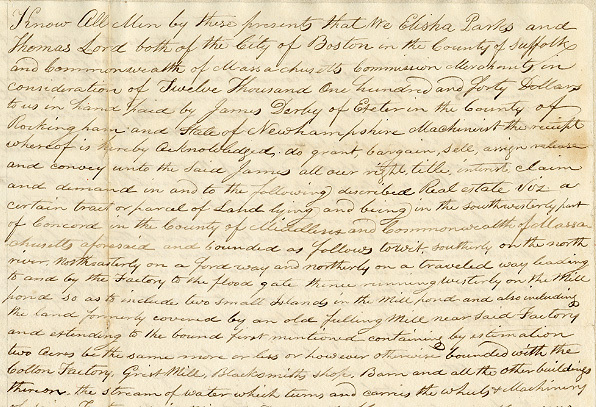
Ephraim Hartwell died in 1816. His grandson, Ephraim Hartwell Bellows, became a third partner in the business in 1813. The business declined in 1817 and John Brown sold a significant portion of his interest to Caleb Bellows, Ephraim's father. When Caleb died in 1823, Bellows purchased the interest. Over the years, Brown and Bellows developed a tense relationship, with Brown suing Bellows in 1824 after Brown sold out to him but never received pay. Bellows eventually sold controlling interest in the mill to Boston merchants Thomas Lord and Elisha Parks. They quickly sold the entire operation to James Derby of New Hampshire. John Brown spent the remainder of his life on his Concord farm. The 1831 deed shown here documents the sale of property by Bellows to Lord and Parks.