21. Westvale Becomes Concord Junction
The end of the Damon Mill era came incrementally to a close, changing the character of the neighborhood with its dissolution just as it had in its growth. In 1899, the buildings were sold to the Concord Rubber Company and the machinery was removed. The Concord Rubber Company employed just fifty people, mostly women, and remained in business for five years. At the same time, the Concord Junction Investment Company purchased the tenements and converted them into apartment housing. The Roger Brown House, known locally as the "1775 House," became a boarding house. In 1903, the Westvale post office was discontinued with services transferred to the Concord Junction post office.
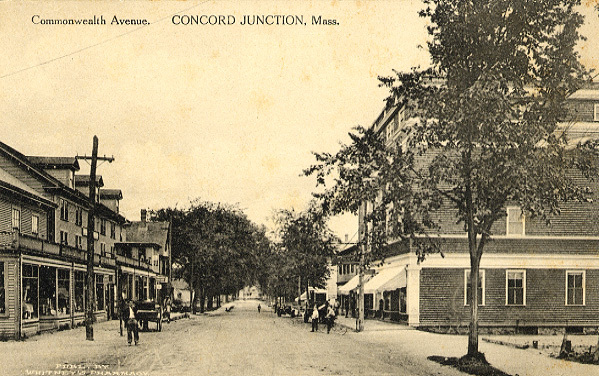
At the turn of the century, the Concord, Maynard, and Hudson Street Railway began operation. Along with the Fitchburg Railroad, merchants, and manufacturers, the new trolley line contributed to the bustling character of Concord Junction. Boston Harness had set up operations in the area in 1890, the Bluine Factory in 1895, and the Allen Chair Factory in 1905. By the time the above postcard was published, Concord Junction possessed its own thriving retail district on Commonwealth Avenue.
The Strathmore Worsted Mills began operating in the Damon Mill complex around 1908, the last mill business to use the site. A boom in the textile industry as a result of World War I was followed by a decline, and Strathmore shut down operations in 1922.