9. Edward Carver Damon's Career
Edward Carver Damon was born in Concord in July 1836 to Calvin Carver and Rebecca Poor Farnham Damon. His education and early training at the mill served him well when he stepped in to succeed his father. Edward ran the mill successfully, particularly during the Civil War era when his father's domett cloth was in demand for use by the U.S. Army. Damon was remembered as a modest man who emphasized caring for his family, his employees, and his community. He was quietly pious, and taught religion classes to members of the mill community. He also acted a superintendant of the Sunday school at Trinitarian Congregational Church. Though his health was often fragile, he worked tirelessly at the mill, providing handsomely for his family and changing the face of the community. A neighborhood developed around Damon Mill, including tenement housing for workers, a school, and a store.
Edward was civically engaged and well-known in the community. For thirty years, he served as director of both the Middlesex Institution for Savings and the Concord National Bank (of which he later became president). He also worked with William Munroe on the establishment of the Concord Free Public Library, and served on the Library Committee, Board of Selectmen, and School Committee. He also served as Water Commissioner, working with others to create a public water supply for West Concord. He was a member of the Concord Farmers' Club, the Saturday Club, and Social Circle. Both Edward and his wife were highly involved in Concord's social and cultural circles as well, attending Concord Lyceum and School of Philosophy lectures and counting the Emersons and Alcotts among their friends and acquaintances.
Through his business acumen, extensive community involvement, and good will, Edward Damon was able to bridge the divide between working-class Westvale and the more affluent Concord Village. In his Social Circle memoir of Edward Damon, Henry F. Smith writes:
“He was elected a member of the Social Circle in 1866, at the age of thirty, which is strong testimony of the regard in which he was held by the men of Concord, especially considering how far he lived from the other members of the Circle.”
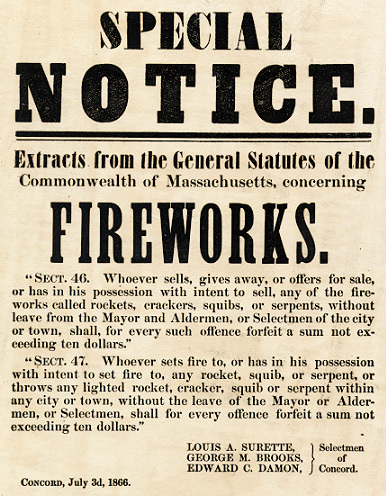
This July, 1866 broadside regarding the sale and use of fireworks was issued by the Concord Board of Selectmen, of which Edward Carver Damon was then a member.