2. Early West Concord
Damon Mill was neither the first nor the only mill in what is now West Concord. Most mills and manufactories in the area were located on the Assabet River, whose current was stronger than the Concord and Sudbury Rivers. The Concord Iron Works, a branch of the Saugus Iron Works, was established on the banks of the Assabet in 1660. It covered hundreds of acres, extending into both Acton and Sudbury and including the 1,000-acre Iron Works Farm. In this operation, bog ore was mined from local swamps and processed at the forge, which was located near the site of Damon Mill. The process resulted in bar iron, which was used in nails and hinges. The iron works was abandoned around 1700, likely a result of the ore's inferior quality.
George Heywood began operating a sawmill on a nearby brook around 1664. He later added a grist mill, which was used for grinding corn. Ironically, Heywood drowned in the Assabet in 1671.
Before 1700, Edward Wright built a fulling mill. Fulling is the final step in the process of weaving cloth in which fabric is cleaned, stretched, and smoothed. By 1715, Lot Conant had opened a grist mill, which his descendants continued to operate throughout the eighteenth century.
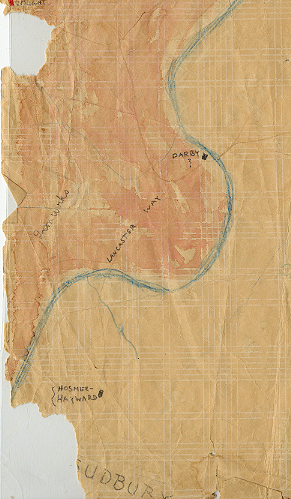
The image on this page shows the West Concord section of a map of the town around 1690, hand-drawn by local historian Ruth Robinson Wheeler.